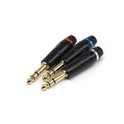

With the development and progress of society, electronic products are gradually developing in the direction of intelligence and integration. In order to improve the performance of electronic equipment, better meet the growing needs of people, and also to ensure the reliability of electronic equipment, people have higher and higher requirements for the quality of equipment. As an important part of the audio connector - the 3.5 mm audio interface has also been greatly developed. Audio interface technology has developed from the initial single coaxial cable connection method to the current multiple methods, including coaxial, optical fiber, twisted pair and so on.
There are two main ways to connect coaxial cables: one is shielded cable (including metal shielding layer and non-metallic shielding layer); the other is unshielded cable (including metal or non-metallic conductor). Both ways have advantages and disadvantages.
(1) The metal shielding effect is good, but the transmission loss is large and the transmission distance is short. At present, most mobile phones and PCs use a coaxial cable connection method with a metal shielding layer. This method can reduce the loss of the signal during transmission, but a lot of stray electromagnetic waves will be generated during the transmission of the signal, which will affect the quality of the signal.
(2) The unshielded cable maximizes the good insulation, low resistance, high anti-interference and high-voltage performance of the cable itself, which greatly improves the transmission quality and signal stability. However, this connection method has a complex structure and high cost.
(3) The twisted pair is a communication connection technology with excellent performance. It has the following characteristics:
a. The twisted pair adopts the structure of coaxial cable, and its signal transmission is more reliable than coaxial cable;
b. The twisted pair has a larger wire diameter to ensure good electromagnetic compatibility;
c. The twisted pair uses a thinner core wire to reduce signal loss during transmission;
d. The twisted pair has a larger wire diameter to improve the distance and stability of signal transmission.